
What is Ultrasonic Flow Measuring?
Ultrasonic flow measurement determines the volumetric flow rate of a liquid or gas in a pipe or conduit. U-F-M uses clamp-on sensors to measure non-invasively from the outside, without breaking open the pipe. This results in less disruption, lower maintenance costs, and quick installation.
There are two main techniques: Transit-Time Difference and Doppler. The most suitable technique depends on the medium being measured, the type of pipe, and the accuracy requirements.
Which technology suits your application?
| Feature | Transit-Time Difference | Doppler |
|---|---|---|
| Medium type | Clear (water, oil, chemicals) | Liquid with solid particles or air bubbles (sludge, waste or process water) |
| Minimal contamination | < 30% solids or air bubbles | Requires reflective particles / air bubbles |
| Sensor configuration | Two sensors (bidirectional) | One or two sensors, depending on model |
| Accuracy | 0.5% – 1% (actual value) | ± 2% or higher, depending on medium |
| Pipe diameter | 3 mm to 6,500 mm | 30 mm to 4,000 mm |
| Typical applications | Drinking water, cooling water, hydraulic oil, chemicals | Waste water, slurries, monitoring overflow / dry run detection |
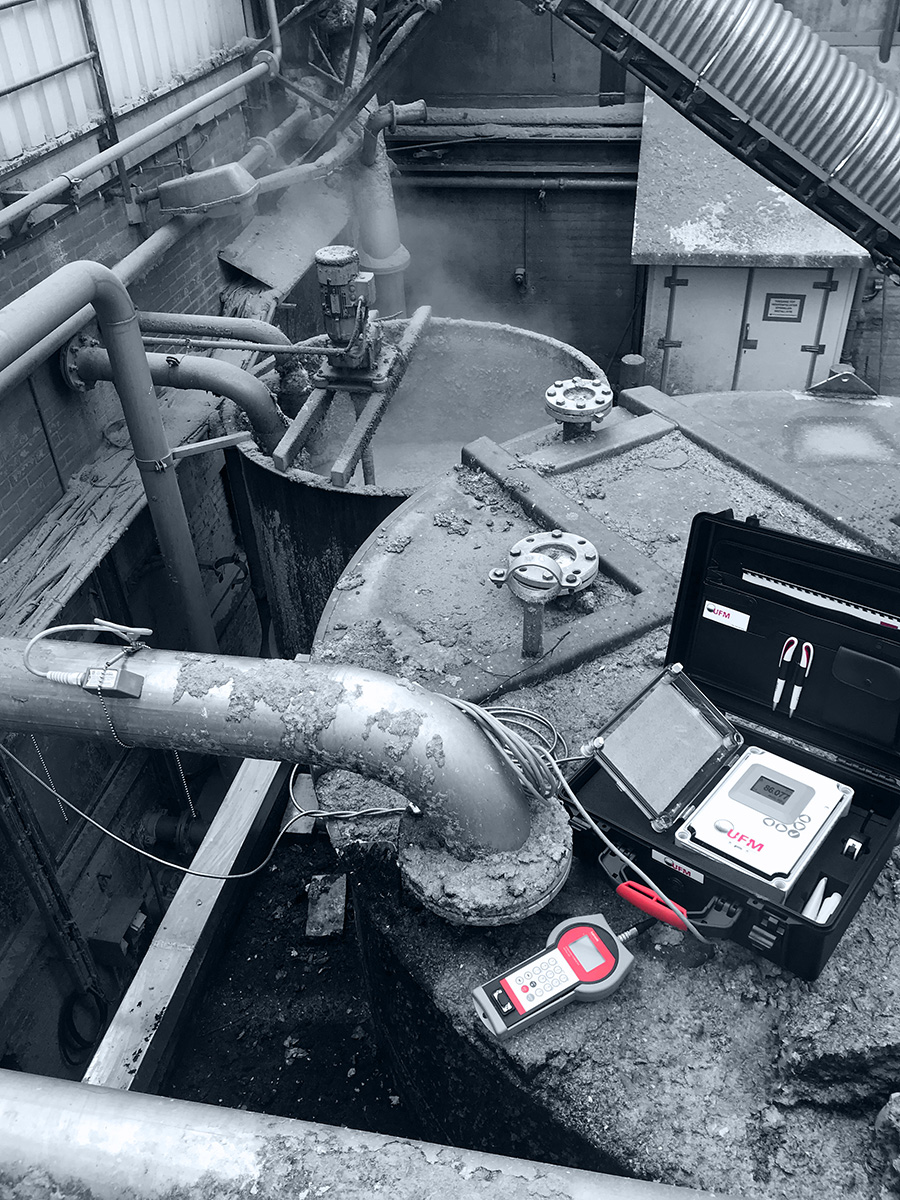
When do you choose which technology?
- Transit-Time Difference is the best choice for clear media, high precision requirements, and variable pipe diameters.
- Doppler is the preferred technology for media containing particles or air bubbles, such as slurries, process water, wastewater, or hydraulic systems with microbubble formation.
Our Support
We help you make the right choice based on:
- Medium (liquid/gas type, degree of contamination)
- Pipe material and diameter
- Desired accuracy (measurement error tolerance)
- Installation context (internal/external line, service environment)
Want to know which ultrasonic flow measurement technique is suitable for your process?
Contact our specialists for advice based on your medium and pipe type.